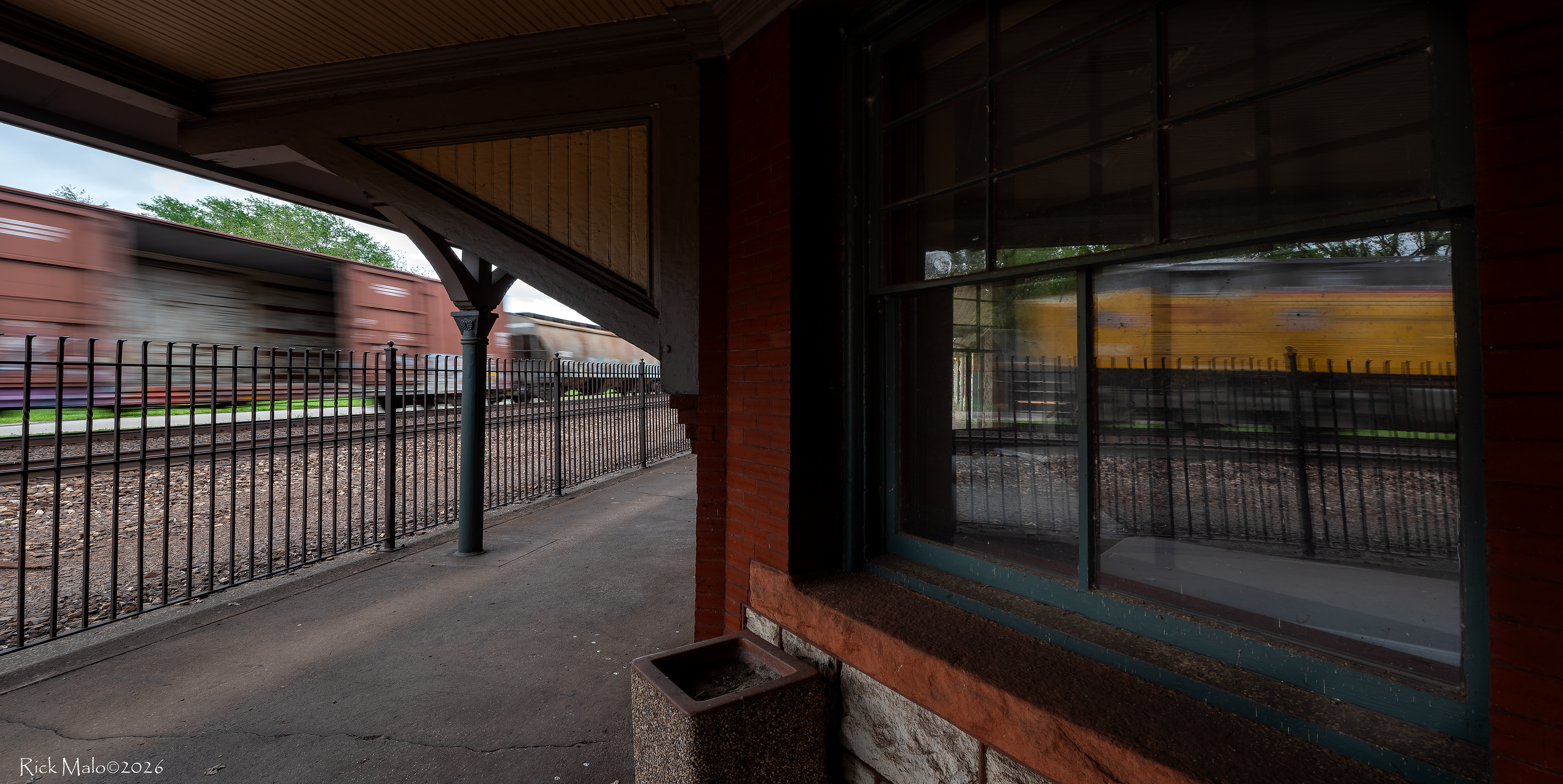
The passengers are long gone.
As is the Rock Island.
And Lord only knows how a Union Pacific 9000 ever bent its six drive axles around the curve.
It’s been seventy years since they did just that in Lawrence, Kansas.
Across the Kaw River, the Santa Fe has morphed into little more than four letters swooshing across the flanks of orange diesels. Their horns are heard for a long way as they wind along the river’s edge and head toward Topeka.
Those of my generation never had the joy of sitting on a depot bench watching the trains roll by and listening to old men tell their stories. We never knew station agents or dispatchers or climbed the stairs and spent a trick with the tower operators.
We grew up in the suburbs, far from the downtown Union Stations, yet we remember them. Christmas packages sent back to family in Chicago needed to go REA, and that meant a trip to downtown Houston.
I was three years old when my grandmother died of a heart attack in her berth on the Texas Chief as she was heading back to Chicago after a visit.
I don’t remember her.
That was 1965 and damn few trains called at Houston Union Station anymore.
Word has it they’ve built a ballpark there now.
*
For most in my generation, our introduction to Don Ball came in the form of the exquisite book “Portrait Of The Rails.”
If it didn’t show up under the Christmas tree of the young railfan, a copy could be found down at the local hobby shop, or, for a young man just starting 7th grade, in the library at Johnston Junior High School, on a shelf very near Victor Hand’s “The Love Of Trains”, Morgan’s “Steam’s Finest Hour”, and a fair selection of Strapac’s Espee Annuals. Seems as the school librarian, Tom Cobb, had an affinity for trains in general and the Southern Pacific in particular. The school railroad club consisted of about 8 or 10 of us, and we met in Mr. Crittenden’s history classroom every Tuesday afternoon at 3:05, Thomas Cobb presiding.
But, as with so many young men, I was easily swayed by shiny things and pretty girls who smelled nice.
*
My copy of “Portrait” is worn. The dust jacket survives, mostly. The adhesive in the binding is cracked and letting go. Certain pages are declaring their displeasure with the situation and are threatening to leave during any one of the next sessions that the book finds itself open in my lap.
Handling with care is required.
Of course, there’s the introduction by Morgan, but Ball is no slouch with words---
Especially when he writes about growing up in Kansas.
“So often, I find myself drifting back into another world, a quiet world of my boyhood, one of an America I can no longer find. Every once in a while, in fact quite often, I shut out today’s invading clamor and return to the fields of crickets and meadowlarks along the railroad tracks of my Kansas youth. My boyhood world seemed uninvaded somehow---
One that was always there, always tranquil, always constant, and one of which I could feel I was a part. Within it, the railroad tracks provided a fascinating, captivating involvement with faraway places and distant horizons. The great trains entered and left as if on a stage, storming through their roles, and departing.”
Many of us never knew that world. We lived it only through the prose and imagery that graced the glossy pages of “Portrait” and other works.
To say we missed a lot would be an understatement.
*
When Don Ball left Lawrence, Kansas for the Northeast, aluminum Bethgons and rotary couplers weren’t a thing. The Powder River Basin was still in the future.
But steel wheels still keened on the curve with the characteristic “SPANG” as freights rumbled past the old depot, not behind Rock Island R-67s and M-50s, or Sweeney-stacked UP Mikes and 2-10-2s, but EMD diesels.
They leaned into the curve just inches from the platform, rattling the windows in the cut stone structure, the rumble of 567s echoing off the grain elevators as they rolled tonnage towards Kansas City, blue exhaust curling upward and swirling around the Sawtooth oak and cottonwoods and the lilac planted along the landscape.
Cars whooshed past, an amazing array of shapes and colors and logos carrying who-knows-what clicking and clacking on their way to distant places.
The end-of-train device contained a cupola with windows and a conductor waving at the kids standing on 3rd Street, the caboose disappearing from view as it slipped past the elevator, block signals showing red at its passing.
And then---the quiet. The birds resumed their chirping.
Those things are now vacant, an America lost forever somewhere on the other side of an ugly black wrought iron fence, remembered only in glossy pages that slowly work loose from their binding.
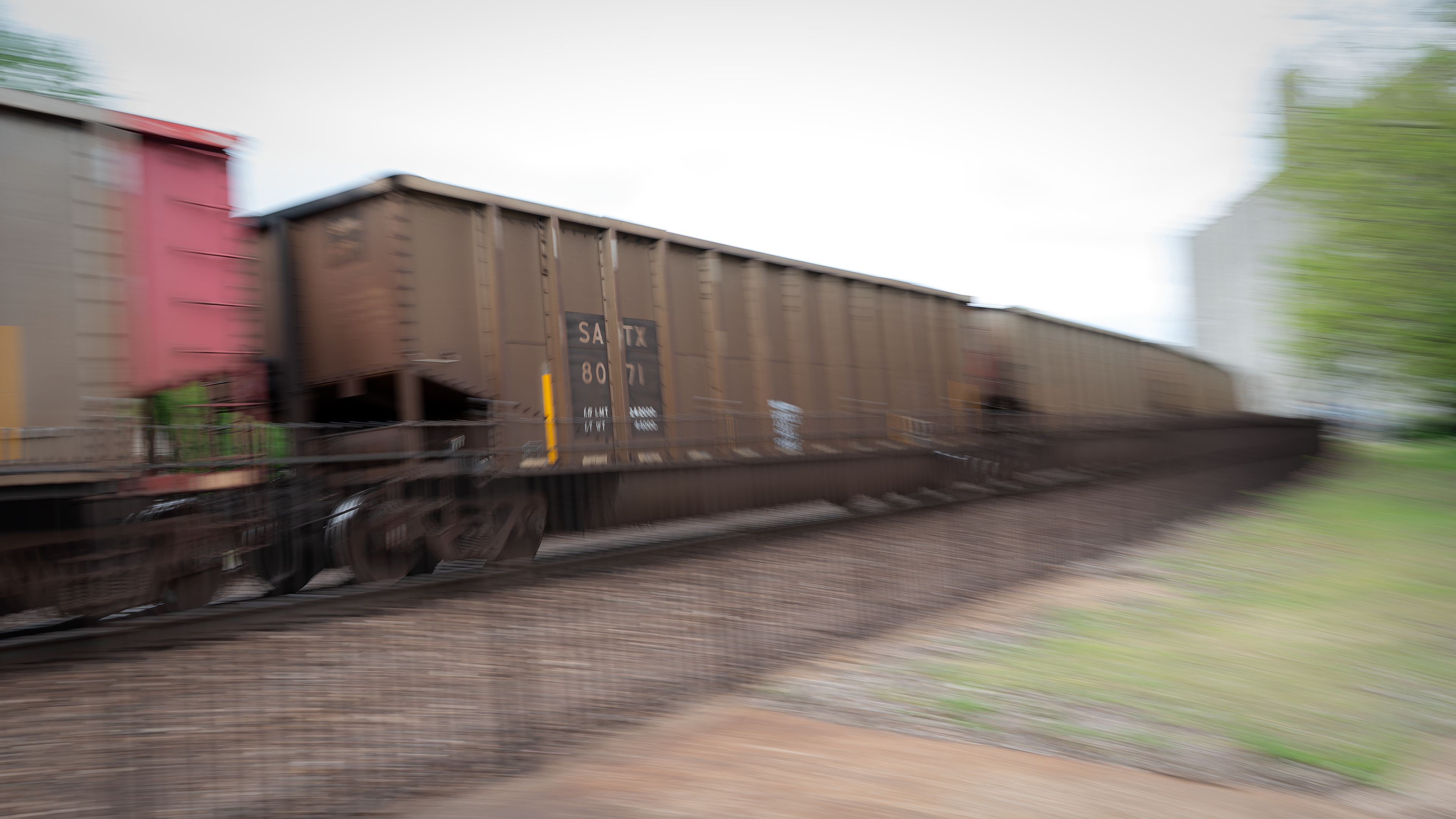
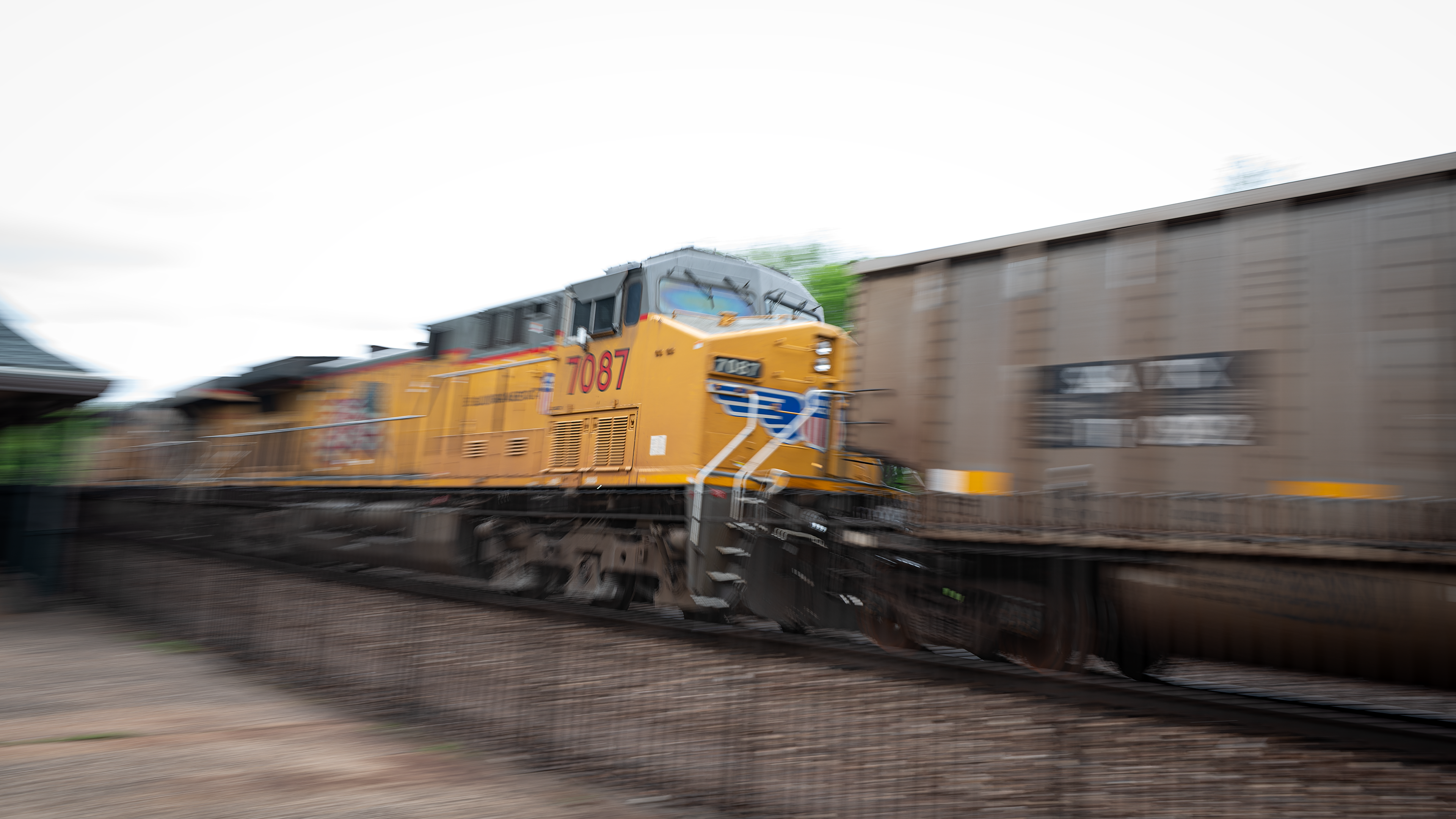
Today, a monster coal drag shakes the ground, the heavy thugga-thugga-thugga-thugga four-stroke cadence and the howl of traction motor fields in excitation vibrate the tympanic membrane with the finesse of a sledgehammer. Big yellow six-axle GE diesels bellow as they bend around the curve, each laying down twice as much tractive effort as a UP 9000. Running 2+4+2, they’ll pull and push Texas-bound gondolas towards the rotary dumper outside of San Antonio.
Hot diesel exhaust washes over an empty platform.
The doors are locked.
The windows rattle.
The sky is cloudy.
The light is awful and soulless and hollow.
But the sound is incredible.
A long heavy train entered as if on a stage---
Stormed through its role---
And departed, slipping out of sight past the big grain elevator..
We listened to it fade away.
A last, distant horn---
Fading---
A rumble---
Fading---
And then nothing.
The birds chirped gaily in the springtime oaks.
There are worse ways that one could spend a gray morning---
Than searching for an America which no longer exists.
---RAM
Rick Malo©2026
Thank you!